One hundred fifty years ago, in August 1868, the Union Pacific Railroad’s tracks in Wyoming extended almost seven hundred miles west from Omaha, Nebraska. End of track was now thirty miles beyond the new bridge over the North Platte River near Fort Fred Steele. The nearby hell on wheels town of Benton turned out to be among the worst ever erected. Because of a lack of potable water, it was one of the shortest-lived.

Hell on Wheels
Benton, Wyoming
In late July, General Grenville M. Dodge, UP’s chief engineer, had convinced General Ulysses S. Grant, republican presidential candidate, to support him in his argument with Thomas “Doc” Durant, UP’s general manager, about where and how to lay the rails. Doc Durant did not cease sending conflicting instructions from his New York headquarters to Silas Seymour, his consulting engineer, who remained in Wyoming. Dodge and Seymour remained at odds until the completion of the first transcontinental railroad.

Chinese Workers
Central Pacific Railroad
Out west, the Central Pacific picked up its pace after completing the arduous task of crossing the Sierra Nevada Mountains. In western Nevada, the new town of Wadsworth sprang up to serve as the supply base for the work across the Nevada desert. Charles Crocker, construction supervisor for the CP, had to tackle a workforce problem in late July that had threatened to bring CP’s tracklaying to a halt. Rumors circulated that in the Nevada desert fifty-foot snakes and twenty-five-foot tall Indians would devour the Chinese workers. About a thousand “celestials” walked off the job before Crocker sent a delegation of Chinamen into the desert to meet real Indians and disprove the fake news.

Brigham Young
On August 14, 1868, General Dodge met with Lewis M. Clement, the Central Pacific’s chief engineer, in Salt Lake City, Utah. This was the first official meeting to discuss where the two railroads should join. The next day, Dodge met with Mormon leader Brigham Young and informed him the railroad would not pass through the capital city. Young was not pleased. On Sunday, August 16, Dodge and his wife and children, who had traveled west with him from end of track by stagecoach, sat beside Silas Seymour in the New Tabernacle and listened to Young berate the railroads. Mormon workers held grading contracts with both the Union Pacific and Central Pacific. Young and his church elders had expected a better outcome from their efforts. Young eventually took the position that the decision to route the railroad north of Great Salt Lake was God’s will.
 In Bear Claws, The Iron Horse Chronicles, Book Two, Will Braddock witnesses the debauchery in Benton, lends a hand to Chinese workers on the Central Pacific Railroad, and meets Brigham Young in Salt Lake City.
Bear Claws won the Silver Will Rogers Medallion for Younger Readers in 2016, and the Wyoming State Historical Society awarded the book first place in fiction in 2016.

 Next on the agenda will be the fourth annual book signing at South Point Casino in Las Vegas, Nevada, mid-way through the National Finals Rodeo. My wife, Barbara, will assist me during the event. Also helping will be our daughter Beth who will fly in from California to reprise her role, in costume, as Jenny McNabb, the principal female character in The Iron Horse Chronicles. If you are in the Vegas area on Saturday, December 8, 2018, stop by South Point Casino between noon and 4 PM and say hello.

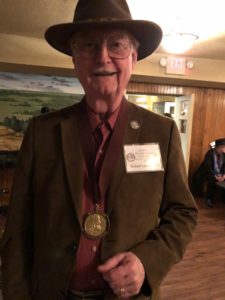
 Golden Spike, The Iron Horse Chronicles, Book Three, has been awarded the 2018 Silver Will Rogers Medallion in the category of Younger Readers. I went to Fort Worth, Texas, to receive this prestigious award and enjoyed wonderful fellowship with the other award recipients while there. On Friday evening, October 26, a great reception, hosted by Charles Williams, the Executive Director of the Will Rogers Medallion Award Committee, kicked off the celebrations.
 I was pleased with the interest in The Iron Horse Chronicles. As you can see from the stacks in front of me, I had all three volumes available: Eagle Talons, Bear Claws, and Golden Spike. The books in the foreground are the hardcover editions from Five Star Publishing. Slightly visible behind the stack of Eagle Talons (to my right) are some large print editions from Wheeler Publishing.


 Michael is a friend and fellow member of Western Writers of America. He has been supportive of my writing from the beginning. His blurbs appear on the back cover of each of the books in The Iron Horse Chronicles trilogy.
 Michael Zimmer is one of today’s premier writers of western fiction. Amazon lists twenty-one of his books in print. His book Poacher’s Daughter won the Western Heritage Wrangler Award for Outstanding Western Novel in 2015. He is also a two-time finalist for the Western Writers of America Spur Award. If you have not yet read Zimmer, you are in for a great treat. Get over to your local bookstore or log on to Amazon and grab one or more of his engaging titles. Michael has a marvelous website where you can learn more about him and his writing:

 Golden Spike is a finalist for the 2018 Will Rogers Medallion Award in the category of Younger Readers. Eagle Talons won the 2015 Bronze Will Rogers Medallion Award for Younger Readers and Bear Claws won the 2016 Silver Will Rogers Medallion Award for Younger Readers.
 RSS - Posts